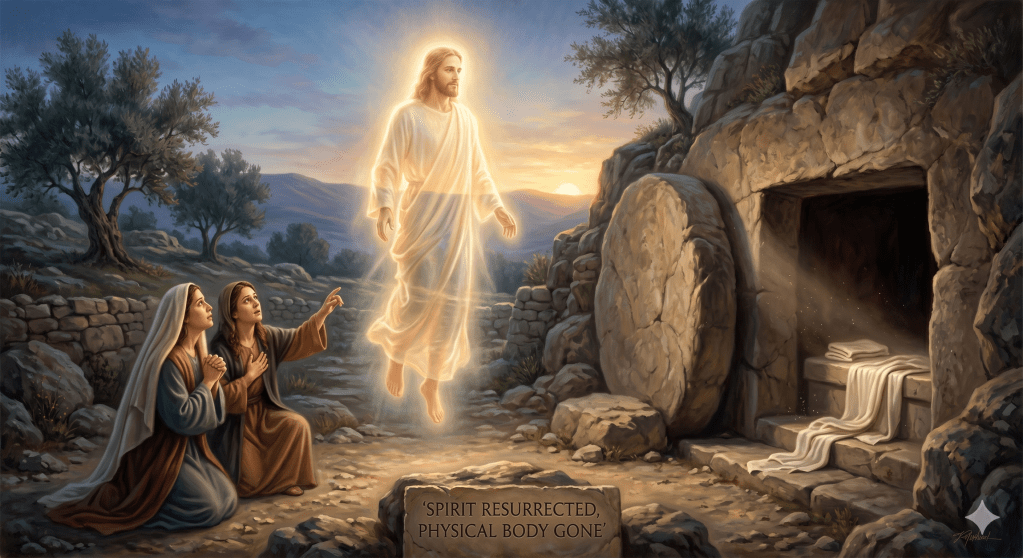
[Summary] This message compares the traditional Christian view of resurrection with the Unification Principle’s view of resurrection and analyzes their theological difference. Whereas Christianity believes in a bodily resurrection in which the body is changed into a spiritual body and emphasizes a transcendent divinity, the Unification Church grasps the human being as the dual characteristics (i-seong-seong-sang) of spirit and body and so believes in a spiritual resurrection. This difference extends beyond doctrine into differences in the Trinity, the view of the Second Advent, and the capacity to embrace other religions. In particular, the view of God that recognizes God as Heavenly Parent becomes the key that breaks down the walls of race and religion and realizes the peace of humankind. Now is the time to seek together such a rational view of faith.
(Preface to the Doctrine of Resurrection in the Exposition of the Divine Principle) If we take the prophecies of the Bible literally, then when Jesus returns, the bodies of all the saints who have already been buried in the earth and decayed must be seen as rising again in their original form (1 Thessalonians 4:16; Matthew 27:52). Because this is the word given by God, from our position of faith we cannot but accept it as it is. Yet because this is a fact that the reason of modern people cannot possibly accept, it ends by bringing great confusion into our life of faith. Therefore, to clarify the true content of this problem cannot but be an extremely important matter.
Resurrection means to live again. And since one must live again because one has died, in order to know the meaning of resurrection we must first clearly know the biblical concepts of death and life.
Today I wish to share together what the fundamental difference is between our family church and Christianity. Recently, while talking with several members, we came to speak about how Christianity’s doctrine of resurrection and ours differ. Yet, unexpectedly, not many people knew that difference precisely. So today, wishing to set out clearly the difference between Christianity and our Unification Church — the heart of comparative religion — I prepared this message.
(Before we enter the main discussion, would you talk for a moment with the member beside you? For two minutes, tell each other what you think the core difference is between the Christian doctrine of resurrection and the Unification doctrine of resurrection.)
Artificial intelligence answers very simply: “Concerning the resurrection of Jesus, Christianity calls it a ‘bodily resurrection,’ and the Unification Church calls it a ‘spiritual resurrection.’” Thus, when one says Christianity believes in a bodily resurrection, people often find it strange, asking how one could believe such a thing by common sense. So today we will unravel the fundamental difference contained in this one sentence.
* Video viewing: The Resurrection of the Body (Pastor Yi Seong-hui of Yeondong Church), 100 seconds.
*1. Christianity Is a ‘Religion of Resurrection’
Christianity calls itself a ‘religion of resurrection,’ so much so that faith in resurrection is the foundation of all its theology. The resurrection they believe in is a ‘resurrection of the body.’ They say that the physical body was suddenly changed into a spiritual body. Yet they say the resurrected body is a body different from the former physical body. So it is not, as we believe, that the body dies and the spirit goes to God’s bosom, but the belief that the body was changed into a spiritual body and went to God’s bosom. Hence they assert that of Jesus neither corpse nor tomb remained.
They confess thus: Resurrection is the event that killed death, the event that put death to death. Through resurrection it was attested that Jesus is God Himself; because he was without sin he was resurrected, and so his sinlessness was proven. Also it was revealed that the saints were justified, and that on the last day the saints too will be resurrected with a body of glory like Christ.
The apostle Paul too said, ‘If there is no resurrection, our faith too is in vain.’ Here there is one thing to point out. A near-death experience and resurrection are different. If one dies and lives again, one dies again in the end; but resurrection, they say, is to become a spiritual body that never dies again.
*2. The Reason Christianity Firmly Believes in Resurrection
The grounds on which Christianity believes in the resurrection of the body are, first, the ‘empty tomb’ event. That the tomb was empty is seen as a characteristic Christianity emphasizes. Second is the change in the disciples. The disciples, who had fled and trembled in fear before the cross, after the resurrection were completely changed into people who preached the gospel at the stake of their lives. If a bodily resurrection had not actually occurred, they say, there is no way to explain this dramatic change.
Yet at the same time, counter-evidence that ‘it was not a resurrection of the body’ is presented no less forcefully: that even Jesus’ closest disciples did not recognize the resurrected Jesus at once, that he passed through locked doors, and that he was too different to be called the same body. As a result, Christians in fact live their whole lives carrying doubt in one corner of their hearts: ‘When I die, will I really be resurrected?’ So, as Christianity came to emphasize a doctrine beyond rational understanding, there arose a tendency to emphasize unconditional belief, rather than logical knowledge, as the foremost virtue. What compresses the core of that belief is precisely the Apostles’ Creed.
*(The Christian Apostles’ Creed)
“I believe in God, the Father almighty, creator of heaven and earth.
I believe in Jesus Christ, His only Son, our Lord,
who was conceived by the Holy Spirit, born of the Virgin Mary,
suffered under Pontius Pilate, was crucified, died, and was buried;
on the third day He rose again from the dead;
He ascended into heaven, and is seated at the right hand of God the Father almighty;
from there He will come to judge the living and the dead.
I believe in the Holy Spirit, the holy catholic Church, the communion of saints,
the forgiveness of sins, the resurrection of the body, and life everlasting. Amen.”
*3. From the ‘Resurrection of the Body,’ All Transcendent Theology Begins
Now, precisely from this literalist faith that ‘the body is resurrected,’ the various transcendent and unrealistic doctrines of Christian theology began to derive. Following the logic, it goes like this. Human beings die. Jesus too is human. Therefore Jesus too dies. Yet Jesus overcame death. Therefore Jesus is not human but God. Here it serves to reinforce the Trinitarian view of God, which was fixed as doctrine 300 years after Jesus.
If Jesus is the Creator God Himself, then the suffering of the cross too had to be not a human failure but an ‘absolute predestination’ planned from the beginning, and it had to be a ‘virgin conception by the Holy Spirit’ rather than the lineage of human parents. Also, the returning Lord too had to come not in a human body but riding the clouds of heaven with supernatural power, raising the bodies of the dead from their tombs and taking them up in a rapture — leading to a superstitious and transcendent view of the last days.
In conclusion, they believe that such a Jesus, being God, is one who has existed from the beginning. Thus all the transcendent and unrealistic theology of Christianity departs, in the end, from the single point of the ‘resurrection of the body.’ But while Jesus was alive, did Jesus and his disciples believe in the Trinity as they do now? No. When Jesus spoke of himself, he always said the Son of Man (inja). The expression ‘Son of Man’ is repeated about eighty times in the four Gospels. And the twelve disciples believed in Jesus as the Messiah who came as the Son of God — they did not believe in him as God Himself. The Trinitarian theology that Jesus is God Himself was deified over hundreds of years, as they tried to justify the bodily resurrection after Jesus’ death.
*4. Then What Is Our View of Resurrection?
The resurrection we believe in is not a resurrection of the body but thoroughly a ‘resurrection of the spirit.’ To understand this, if one knows precisely the dual characteristics (i-seong-seong-sang, 二性性相) of the Unification Principle, everything is resolved.
Every being exists without exception in two relational characteristics: internal nature (seong-sang) and external form (hyeong-sang), and positivity (yang) and negativity (eum). The external form is the ‘second internal nature,’ and internal nature and external form resemble each other. The two are distinguished but cannot exist independently, apart from each other. Beginning from God, no created thing whatsoever exists except through the two characteristics of internal nature and external form.
Positivity and negativity too exist as dual characteristics. Negativity cannot exist alone without positivity. They exist only in a mutually relational relationship. This is an absolute law that applies from God to the created world and to the spirit world. Even a neutron, internally, forms neutrality by the balance of positive and negative of differing qualities.
If one splits matter and splits it again, in the end it becomes energy (E) that can no longer be split. Yet even in this energy there must be together an ‘action of giving’ and an ‘action of receiving’ for it to appear as force. If these two actions are absent altogether, it becomes nothing, a 0. This ‘give-and-take action (su-su action)’ is precisely the action of love, the first power of love that created heaven and earth. We call this ‘God.’ And if we express the rigid philosophical expression ‘God of dual characteristics’ as a warm relational view of God with human beings, we call it ‘Heavenly Parent.’
Therefore, at the very beginning there was the internal nature of the ‘idea of giving and receiving and loving,’ and the external form of the force that appeared as its result came to act. This is precisely God. Because creation began from here, He becomes the Creator, and because this starting point never changes eternally, He becomes the Absolute Being, the Only Being, the Eternal Being. Beginning from this one, and passing through an enormous span of time, order and law and balance were established, and on the Earth, equipped with the best environment, minerals, plants, animals, and human beings were created in turn according to order.
Therefore, every human being necessarily resembles the dual characteristics of God and exists as spirit and body, as male and female. Then one might ask: when a person dies, the body vanishes and only the spirit remains, so does one not come to exist with only internal nature, without external form? No. Because internal nature and external form are an eternal principle, the spirit self too exists equipped with the internal nature of intellect, emotion, and will (ji-jeong-ui) and divinity, and with the external form of a spiritual form. This is an absolute principle from which no being can escape.
*5. Jesus’ Resurrection Was a ‘Spiritual Resurrection’
Until now, no religion, no philosophy, no science has systematized the fundamental principle of dual characteristics — that the human being was created as spirit and body. So they firmly believe that Jesus’ body being changed into a spiritual body is the resurrection. But if one believes that Jesus too was born as the only begotten Son of God, having a finite body and an eternal spirit self, and that he returned the finite body to the earth and, completed as the eternal spirit self, returned to God, then Christianity would not have gone the way of an unscientific, superstitious religion as it has today. So Christian theology fell into a subtle relationship of opposition with science.
*6. The Difference in the View of Resurrection Leads to Conflict with Other Religions
Thus the view of resurrection that ‘Jesus is God’ gave rise to endless conflict with other religions. If one believes in Jesus as God Himself, then every religion that does not believe in Jesus becomes a religion that believes in something vain. It came to show an exclusive attitude that could not embrace other religions — rejecting Buddhist statues as idol worship, denying Islam’s Allah, and so on. Toward all indigenous religions too, it says, ‘Since they do not believe in Jesus as God, they are all false.’ It holds that only Jesus is the Creator God.
Looking at the Unification Church’s True Parents through precisely this view of resurrection, people react: ‘The Unification Church does not even hang a cross; only Jesus is God — why believe in a human being?’ ‘Jesus was conceived by the Holy Spirit, but Mun Seon-myeong and Han Hak-ja were born of parents, so they are merely human.’ ‘Jesus was resurrected and ascended to heaven, so he must come down from heaven just as he was — how can one believe in a person born as a baby?’ ‘If Jesus had returned, my own body, which believed well, should already have been resurrected, yet it remains as it is. Does that then mean the Bible is false?’ — and so they rebel.
*7. God the Father, or Heavenly Parent?
And in Christianity they say God the Father, do they not? Why can they not even imagine the words ‘God the Mother’? They say Jesus is the Son and the father of humankind. And Jesus is God. So there is only God the Father. Since God is one, a Heavenly Mother cannot be imagined. That is why the teaching is important — that positivity and negativity too necessarily exist in the relational relationship of dual characteristics. Had they known this absolute principle of dual characteristics, then if there was an only begotten Son, there must necessarily be an only begotten Daughter too. So the one in whom the only begotten Son returned is True Father, and the one who came as the only begotten Daughter of the First Advent is True Mother. Only when the two become one body and are at last completed as True Parents can Heavenly Parent appear.
When the view of God as Heavenly Parent settles in the heart, the heart of the Heavenly Parent, who aches all the more because of the sins of the human children, is understood. Also, the recognition that all races of humankind are brothers and sisters to one another at last takes root. But because they call God and Jesus ‘Lord (ju),’ it becomes a relationship of master (主人) and servant. Because they understood the relationship of God and human beings only vertically, as a strict master-servant relationship, when the Christian nations of history committed the error of dominating and enslaving other races, they could not apply a theological brake.
Also, if one holds an evolutionary view of the human being, the five-colored races are merely ‘different races’ whose skin color changed according to environment. Even if there is a common bond of ‘human,’ the heart of ‘brothers and sisters’ does not arise. Rather, as evolution says, one comes to see the other as a rival in the survival of the fittest — dominate or be dominated. Thus, according to how one views God — whether as no God, as master, as father, or as parent — it is determined whether humankind becomes enemies, strangers, or brothers and sisters to one another. In this way the view of God determines how human being and human being treat each other.
Today, starting from the problems of the Christian view of resurrection, we have organized our Principle view through comparative religion. The Unification Principle is the final truth that can complete the ideal of peace for humankind. And that, centering on True Parents, we sought out and proclaimed ‘Heavenly Parent’ is a thing that changes the very future of humankind. I bless you that, engraving this core principle on your hearts, you may become a center that sets the world right.
 A daily life that resembles the heavens 空に似た日常
댓글 남기기